
IUL vs. Whole Life: Which is right for you
The Great Life Insurance Debate: IUL vs. Whole Life (2026 Edition)
When it comes to permanent life insurance, the debate often feels like a choice between two religions. On one side, Whole Life enthusiasts point to century-old guarantees and stability. On the other, Indexed Universal Life (IUL) proponents highlight stock market-linked growth and flexible premiums.
As of 2026, the landscape has shifted. Higher interest rates have boosted dividends for Whole Life, while new regulations have made IUL illustrations more transparent. Here is a fair, balanced look at how these products actually work.
Here's a list of questions to ask your agent when shopping around.
Whole Life: The "Safety First" Foundation
Whole Life is the "set it and forget it" option. It is designed for those who value absolute certainty and want a guaranteed outcome for their estate or legacy.
The Pros:
Guarantees: Your premium, death benefit, and a minimum cash value growth rate (typically 2–4%) are all guaranteed.
Dividends: If you buy from a mutual company, you may receive annual dividends. In 2026, major carriers have announced strong dividend interest rates (some as high as 6.25% to 6.60%).
Bundled Costs: The "Cost of Insurance" (COI) is averaged out over your entire life. You pay more than the actual cost of insurance when you are young to "pre-pay" the high costs when you are old. This makes the policy immune to "exploding" costs later in life.
The Cons:
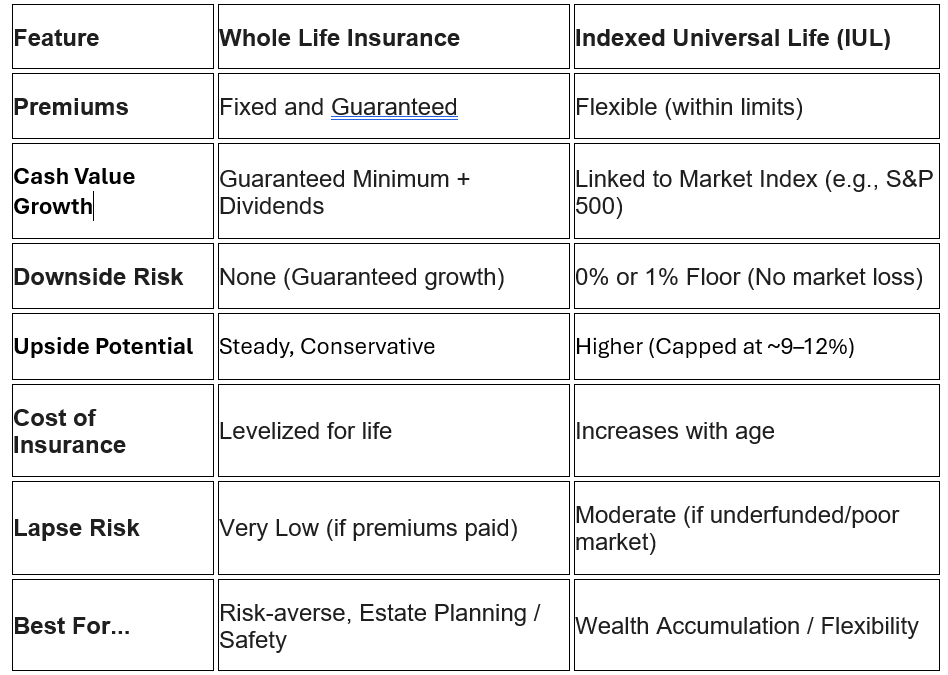
Higher Initial Cost: Premiums are significantly higher than IUL or Term insurance.
Rigidity: Premiums are fixed. If your income drops, you must still pay the full amount or use cash value to cover it, which can deplete the policy.
Indexed Universal Life (IUL): Performance & Flexibility
IUL is a "hybrid" product. It offers some of the upside of the stock market without the risk of losing principal due to market crashes.
The Pros:
Growth Potential: Your cash value is linked to an index like the S&P 500. While you don't own the stocks, you earn interest based on index performance, often up to a "cap" (e.g., 9%–12%).
The Floor: Most IULs have a 0% or 1% floor. If the market drops 20%, your account earns that minimum floor rather than losing value.
Premium Flexibility: You can adjust your payments up or down as your financial situation changes—a "superpower" for entrepreneurs or those with fluctuating incomes.
The Cons:
Rising Costs: Unlike Whole Life, the COI inside an IUL increases every year as you age. If the market underperforms for several years, those rising costs can eat into your cash value.
Complexity: Caps, participation rates, and spreads can be changed by the insurance company after you buy the policy.
The Mechanics: Understanding the "Floor vs. Cap" Trade-Off
One of the most common misunderstandings in the IUL world is the "guaranteed floor." While it is true that many modern products offer a floor of 1% (rather than the standard 0%), this protection comes with a mathematical trade-off.
Insurance companies use a portion of your premium to buy "options" on a market index. To offer you a higher floor (more protection), they have to spend more on those options, which usually results in a lower cap (less upside).
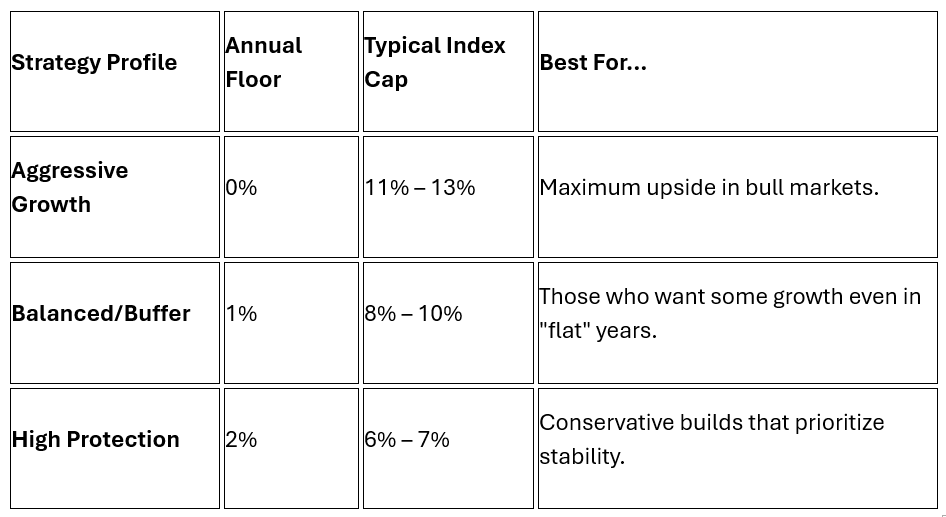
Pro Tip: Always ask for an illustration that shows the "Internal Rate of Return" (IRR). A 12% cap sounds great, but if the market hits 15%, you only get 12%. Conversely, a 1% floor is helpful, but you must account for the policy's internal "drag."
The Reality Check: The "Hidden Fees" Checklist
Transparency is key when evaluating permanent life insurance. Because these are "bundled" products, the fees aren't always on the front page of the brochure. Here is what is actually happening under the hood:
Premium Expense Charges: A percentage taken off the top of every dollar you pay before it even hits your cash value. (Commonly 5–10%).
Cost of Insurance (COI): The actual price of the death benefit. In an IUL, this is "Annual Renewable Term" pricing, meaning it increases every year as you get older.
Expense Charges/Admin Fees: Monthly flat fees for maintaining the policy, often higher in the first 10 years.
Surrender Charges: Fees applied if you cancel the policy early (typically within the first 10–15 years). This is why these are long-term commitments, not short-term savings accounts.
While IUL is often criticized for its 'increasing cost of insurance,' Whole Life is not free of costs. The difference is certainty. With Whole Life, you pay a higher premium upfront to lock in those costs forever. With IUL, you pay a lower premium now but 'buy' the risk that costs might outpace growth in the future.
The "Death Benefit" Mystery: Do You Get the Cash Value Too?
Many people believe that if they have $100,000 in cash value and a $500,000 death benefit, their family gets $600,000. In a standard Whole Life policy, this is usually not the case. Here is how the "Net Amount at Risk" works for both:
Whole Life: The "Equity" Model
In a standard Whole Life policy, your cash value is technically part of the death benefit, not an addition to it.
How it works: Think of it like a home mortgage in reverse. As your cash value (equity) goes up, the insurance company’s "risk" (the actual insurance part) goes down.
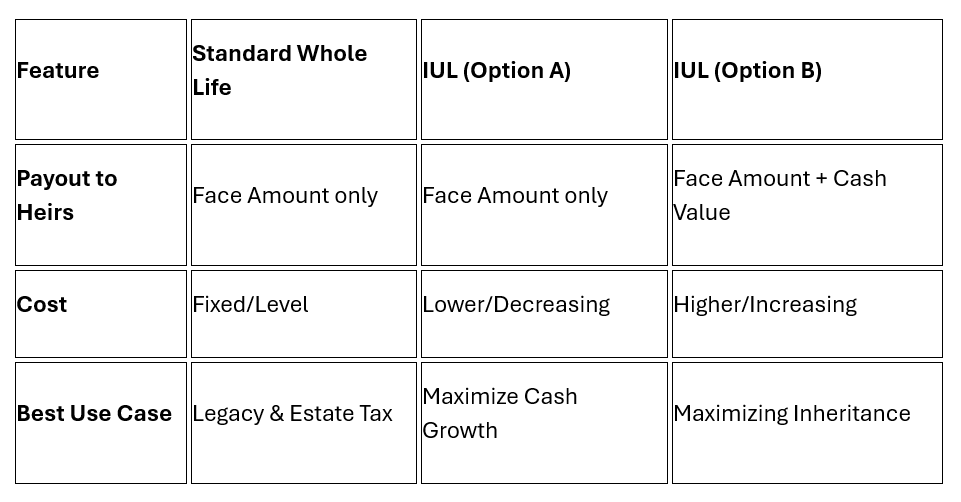
At Death: If you have a $500,000 policy and $100,000 in cash, the company pays your heirs $500,000. They essentially keep the $100,000 of cash and add $400,000 of insurance to reach the total.
The Exception: If you use your dividends to "Purchase Paid-Up Additions" (PUA), you are essentially buying tiny extra mini-policies. In this case, your death benefit does increase over time, and your heirs receive the original face amount plus all the extra death benefit bought by those dividends.
IUL: Option A vs. Option B
Indexed Universal Life is more transparent about this choice. When you sign the contract, you choose how the payout is structured:
Option A (Level Death Benefit): Similar to Whole Life. As your cash value grows, the death benefit stays the same. If you die, the family gets the face amount (e.g., $500,000), and the cash value stays with the house. This is cheaper because the "Cost of Insurance" drops as your cash grows.
Option B (Increasing Death Benefit): Your family gets the Face Amount PLUS the Cash Value. If you have a $500,000 policy and $100,000 in cash, they get $600,000.
The Catch: This is significantly more expensive. Because the insurance company is on the hook for the full $500,000 regardless of how much cash you have, the monthly fees (Cost of Insurance) are much higher.
The Loan Factor: If you have an outstanding loan when you die, the formula is simple: Total Death Benefit - (Loan Principal + Accrued Interest) = Net Payout. ---
The goal for many is to use the cash value while they are alive. If you spend your cash value down through tax-free loans in retirement, you are effectively "winning" by using the money while you're here and leaving the remaining death benefit to your heirs.
Important Warning: If you have a Policy Loan outstanding when you die, that amount is subtracted from the death benefit.
Example: $500,000 Death Benefit - $50,000 Loan = $450,000 Payout to Beneficiaries.
Comparison at Death
🚩 3 Red Flags to Watch For
When an agent hands you a 40-page projection (an "illustration"), it is easy to get lost in the sea of numbers. As of 2026, regulators are cracking down on these specific "traps":
🚩 Red Flag #1: The "100% Current Scale" Assumption
If a Whole Life illustration shows the same high dividend rate (e.g., 6.5%) every single year for 50 years, be skeptical. Dividends are not guaranteed.
The Reality Check: Ask to see the "Guaranteed" column. If the policy only "works" if the company maintains its highest dividend in a decade, your plan is built on hope, not math.
🚩 Red Flag #2: "Maximum Illustrated Rates" on IUL
For IUL, agents often illustrate at the maximum legal rate (currently capped around 6–7%). While this is allowed, it assumes the stock market will provide a steady, smooth return every single year.
The Reality Check: The market doesn't work in a straight line. Ask for an illustration at 5% or even 4%. If the policy lapses at age 85 under a 4% return scenario, you are looking at a "ticking time bomb" that will require massive extra payments later in life to keep it active.
🚩 Red Flag #3: The "Vanishing Premium" Myth
If an agent tells you that you only have to pay for 10 years and then the policy is "free" forever, proceed with extreme caution.
The Reality Check: In both products, the "vanishing premium" is just a projection that dividends or index gains will cover the costs. If interest rates drop or the market stays flat, that "vanished" premium will reappear, and you’ll be on the hook for those payments again or risk the policy lapsing.
Comparison Guide
Summary: Which Lever Should You Pull?
Choose Whole Life if: You want a financial "anchor." If you are looking for a guaranteed death benefit to fund a trust, pay estate taxes, or provide a legacy, the predictability of Whole Life is unmatched. It is a "bond-like" asset that performs reliably regardless of economic volatility.
Whole Life is your Financial Foundation. It is the "tortoise" in the race—slow, steady, and guaranteed to cross the finish line exactly where you expected. It’s ideal for high-net-worth individuals who want a "Safe Bucket" for their money that isn't correlated to the stock market.
Choose IUL if: You are still in your high-earning years and want a tax-advantaged vehicle with more "horsepower." If you value the ability to skip a premium during a lean month or overfund the policy during a bonus year—and you are comfortable with the idea that some years might yield 0% returns—IUL offers a dynamic tool for wealth building.
IUL is your Wealth Accelerator. It is more like a performance vehicle—it can go faster and offers more agility, but it requires a driver who is paying attention to the road. It’s ideal for younger professionals or entrepreneurs who want tax-free growth and the flexibility to pivot their strategy as their income fluctuates.
Important Note: Both products allow for tax-free policy loans, making them popular for "Infinite Banking" or supplemental retirement income. However, if a policy lapses while a loan is outstanding, it can trigger a significant tax bill.
Choosing between IUL and Whole Life isn't about finding the "better" product; it's about finding the right risk-to-reward ratio for your specific stage of life. If you can’t decide, many people actually choose a "blended" approach, holding a base of Whole Life for certainty and an IUL for growth.
Click here for a list of questions to ask your agent when shopping for life insurance.
The path may be rough and complicated but one step at a time gets us there. Thanks for following us on the path to stewarding our God-given resources. Cheers!